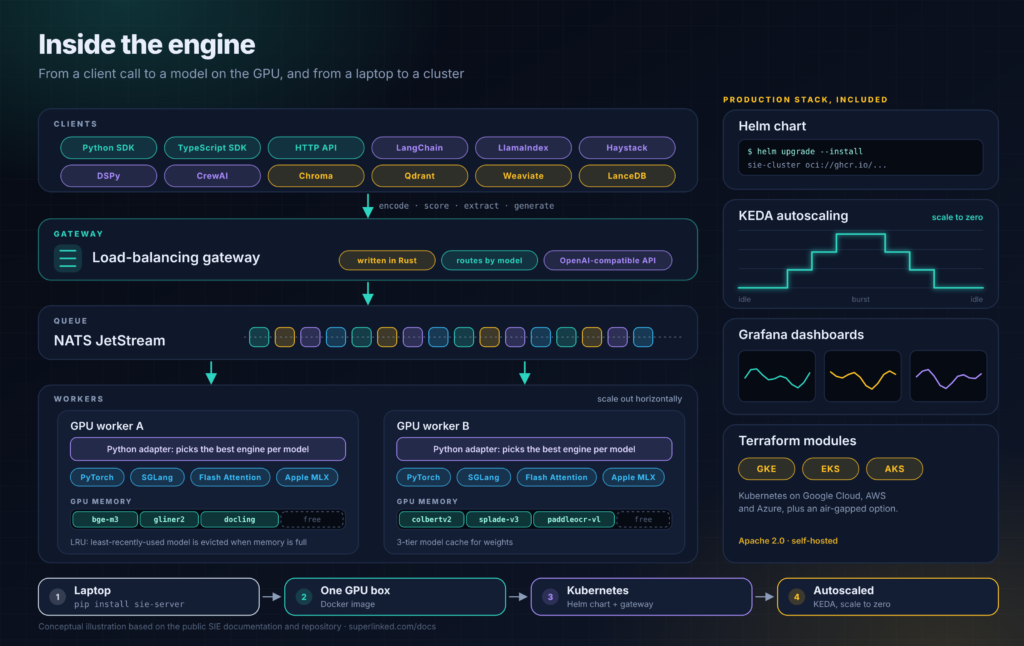

Meet SIE: the Apache 2.0 engine that runs embeddings, rerankers, extractors and text generation behind one simple API.
Picture a small engineering team building an AI assistant for a law firm. The demo works on Monday. By Friday the team is running four separate servers: one for embeddings, one for reranking search results, one for pulling names and dates out of contracts, and one for generating answers. Each has its own setup, its own bugs, its own GPU bill. Nobody planned it this way. It just happened, one model at a time.
This is the quiet tax of modern AI. The headline models get the attention, but real products lean on a crowd of smaller ones working behind the scenes. Running that crowd is where much of the time goes.
A tool called SIE, short for Superlinked Inference Engine, is built to fix exactly that. It is an open-source server, released under the Apache 2.0 license, that serves more than 100 models from one running instance. It replaces the patchwork of per-task servers with a single cluster, where each model loads only when it is needed. This article explains what it does, how it works, and how little code it takes to use.
The Problem Nobody Puts on the Slide
When people talk about AI infrastructure, they usually mean the big language models. Tools like vLLM, TGI and SGLang exist to serve those giants well. But a production AI system rarely needs just one model. A typical search-and-answer product needs several:
- an embedding model, which turns text into numbers so a computer can search by meaning;
- a reranker, which re-reads the best search hits and puts them in a smarter order;
- an extractor, which pulls out names, dates and amounts from text;
- an OCR model, which turns scanned PDFs into clean text;
- a language model, which writes the final answer.
Until now, teams usually ended up with one server per job. Superlinked’s pitch is that this small-model stack, the one agents and search systems depend on, never got a dedicated serving tool of its own.
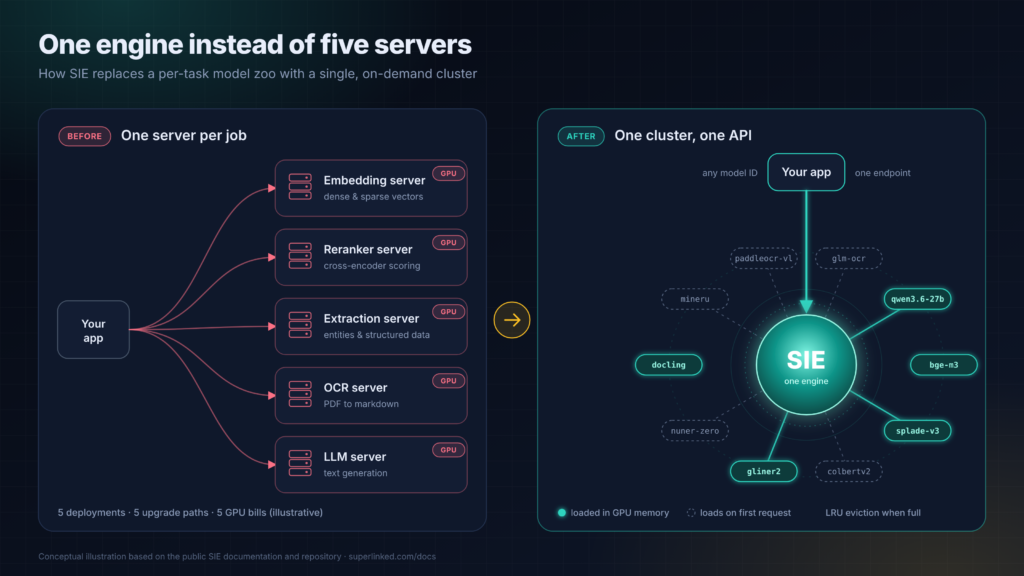
The cost of the picture is not just money. Each server is something to deploy, monitor, upgrade and debug. SIE collapses them into the right-hand picture.
What SIE Actually Does
SIE exposes a small set of verbs. Learn four words and you know the whole product.
| Verb | What it does | Everyday example |
|---|---|---|
| encode | Turns text (or images) into vectors | “Find documents similar to this question” |
| score/td> | Ranks candidate results against a query | “Which of these 20 hits is the best answer?” |
| extract | Pulls structured facts out of content | “Who signed this contract, and when?” |
| generate | Writes text | “Summarize these passages in one sentence” |
Start it on a laptop with two commands:
pip install “sie-server[local]” && sie-server serve # runs on http://localhost:8080
pip install sie-sdk
Then ask it for an embedding:
from sie_sdk import SIEClient
from sie_sdk.types import Item
client = SIEClient(“http://localhost:8080”)
result = client.encode(“sentence-transformers/all-MiniLM-L6-v2″, Item(text=”Hello world”))
print(result[“dense”].shape) # (384,)
The first call downloads the model’s weights from Hugging Face and loads them. After that, calls typically return in milliseconds.
The design choice worth noticing is how models are swapped. Want a stronger, multilingual embedder? Change one string. The documentation suggests BAAI/bge-m3, and the call stays identical:
result = client.encode(“BAAI/bge-m3″, Item(text=”Hello world”))
No new server. No new deployment. The same applies to OCR models and others in the catalog.
A Search Pipeline in Thirty Lines
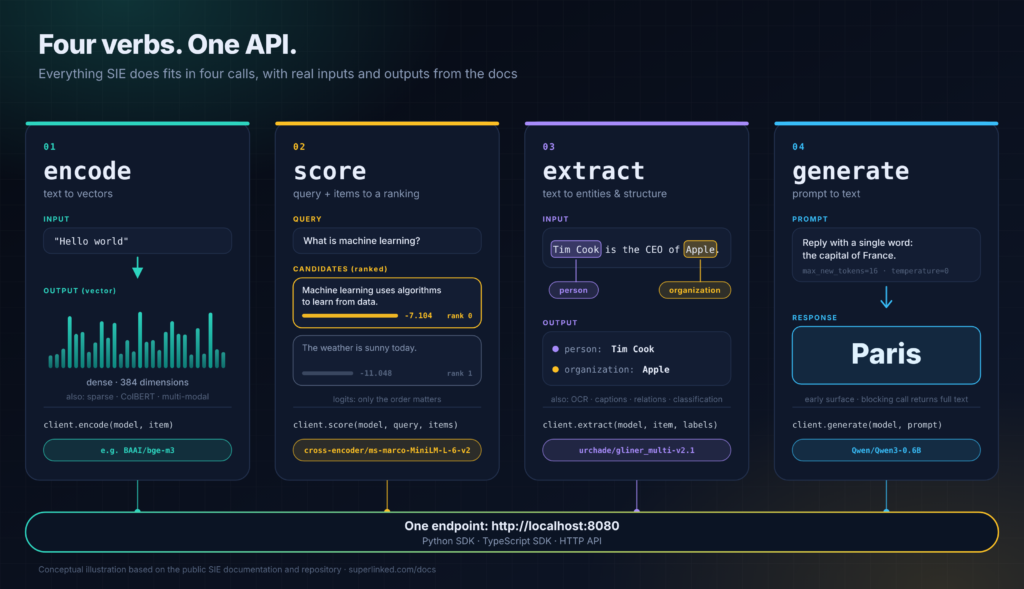
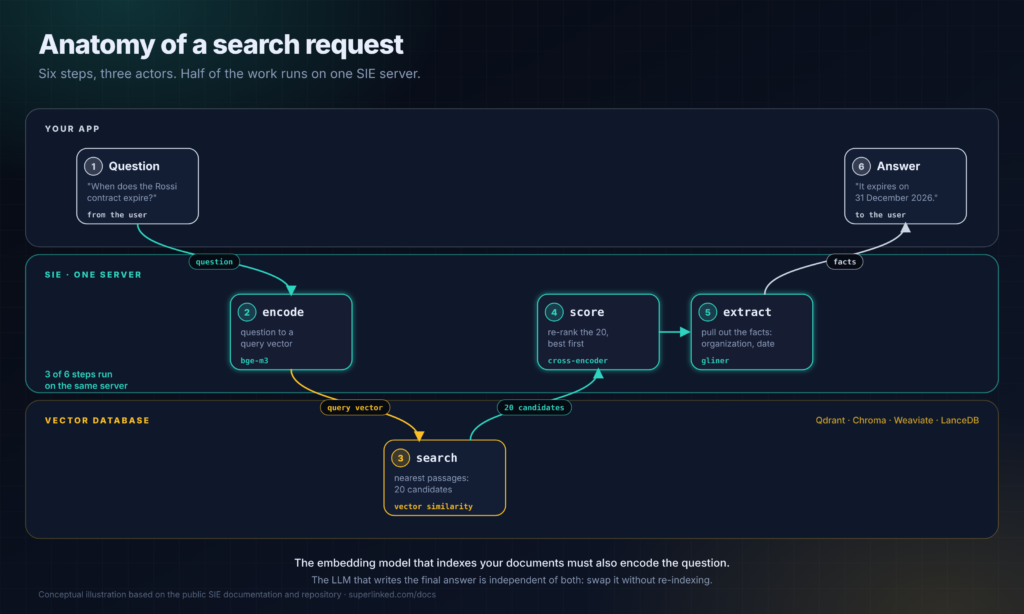
Here is how the pieces fit together in a realistic search workflow.
A user asks a question. The system finds likely passages, re-ranks them, and pulls out key facts.
And the code behind the SIE steps:
One honest note on this example. The re-ranker shown is the one from the official quickstart, and it is tuned for English. For other languages you would pick a multilingual reranker from the model catalog. I have also kept the vector search in plain NumPy for clarity. In production you would hand that step to a vector database. SIE has integrations for Chroma, Qdrant, Weaviate and LanceDB, as well as for LangChain, LlamaIndex, Haystack, DSPy and CrewAI.
A common point of confusion: the embedding model has nothing to do with the language model that writes the final answer. They are independent. What must stay consistent is the embedding model used for indexing and for searching. Swap it, and you re-index your documents. Swap the answer-writing LLM, and nothing else changes.
From Laptop to Production, and When to Skip It
Running one model server is easy. Running many, reliably, is hard. SIE leans on three ideas to make the second case manageable.
Models load on demand. The server starts instantly and loads each model the first time it is requested. When GPU memory runs short, the least recently used model is evicted to make room. One GPU can therefore host a catalog far larger than what would fit in memory at once.
The right engine is chosen automatically. Under the hood SIE wraps PyTorch, SGLang, Flash Attention and Apple MLX, and picks the best one for each model.
Production tooling ships in the box. The repository includes a load-balancing gateway, Helm charts, autoscaling with KEDA (including scale to zero), Grafana dashboards, and Terraform modules for the major clouds.
The same SDK calls work at every stage. Only the URL changes: from localhost:8080 to the address of your cluster.
There are trade-offs. On a cluster that scales to zero, the first request can hit a cold start of several minutes while workers spin up, and the SDK offers a wait_for_capacity=True option to handle that gracefully. The generate feature is described in the docs as an early surface. And SIE is not trying to replace specialist servers for very large language models.
So when does it make sense?
- You run lots of embedding or reranking traffic and per-token API fees add up.
- Privacy or data-residency rules keep your data on your own infrastructure.
- You are juggling several model servers and want one.
When might you skip it?
- Your volume is small, and a managed API is simpler.
- Your main need is serving one big LLM at top speed.
For teams that want the engine without running GPUs, Superlinked also sells a managed version.
The bigger story is a shift in how AI systems are built. The industry spent years racing to make the biggest model. SIE bets on the opposite end of the stack: that much of the useful work is done by small, specialized models, and that the winning move is making them boring to operate. If that bet is right, the most valuable AI infrastructure of the next few years may be the kind nobody notices.