I’m thrilled to announce that I’ll be moderating the upcoming roundtable ITDACH Roundtable meeting on Artificial Intelligence and IoT on April 25th, 2024. We’ll be delving into some fascinating topics, including Generative AI in the Enterprise, enhancing creativity and content generation, Natural Language generation (NLG) for business communication, and AI-driven product and service Innovation. We’ll also be exploring the importance of personalization and customer experience, and how to make the most of new technology in corporate organizations.


I will speak at the next Leadership Meeting at Incyte, 14th February 2024 | Morges, Switzerland.
I am pleased to present an overview of the presentation I will make to the Leadership Team of Incyte, a Pharmaceutical Company based in Morges, Switzerland.
I will focus on the transformative role of Generative AI across various sectors in the pharmaceutical industry, including its impact on workforce and key applications in drug development, clinical and commercial supply, manufacturing, quality assurance, and regulatory submissions.
Generative AI and Its Impact on Workforce and Employees: This section will explore how generative AI is reshaping the workforce landscape. We will delve into the potential for enhanced productivity, the creation of new roles, and the necessity for reskilling and upskilling employees to adapt to AI-driven environments.
Application to Drug Development: We will examine how generative AI accelerates drug discovery processes, from identifying new drug candidates to predicting drug-target interactions. The focus will be on the reduction of time and costs, and the increase in the efficiency of R&D processes.
Application to Clinical and Commercial Supply – Planning & Forecasting: This segment will cover how generative AI can revolutionize supply chain management. We will discuss AI’s role in demand forecasting, inventory optimization, and enhancing the agility of supply chain responses to market changes.
Application to Manufacturing: Here, we will explore the integration of generative AI in manufacturing processes. The emphasis will be on predictive maintenance, process optimization, and how AI can aid in scaling production while maintaining high-quality standards.
Application to Quality Assurance: This part will address the utilization of generative AI in quality assurance, focusing on automated quality checks, real-time monitoring, and predictive analytics to anticipate and prevent quality issues.
Application to Regulatory Submission (CMC Submission): Finally, we will discuss the application of generative AI in regulatory submissions, especially in Chemistry, Manufacturing, and Controls (CMC). The focus will be on how AI can streamline data analysis, enhance documentation accuracy, and ensure compliance with evolving regulatory standards. This application promises to significantly reduce the time and resources required for regulatory submissions, while maintaining the highest levels of accuracy and compliance.
Link to the website of the Incyte: https://incyte.com/


I will speak at the next “Young Executives Committee YEX meeting” in collaboration with the Camera di Commercio Italiana per la Svizzera (CCIS), 28th November 2023 | Zurich, Switzerland.
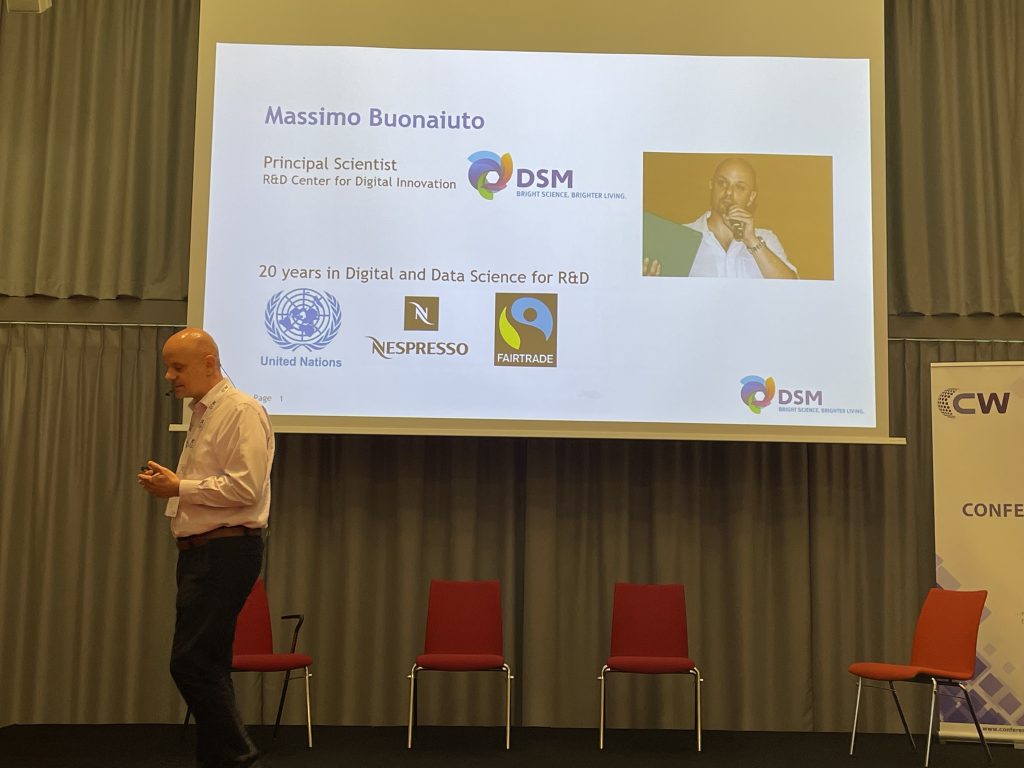
In this compelling presentation, Massimo Buonaiuto, an international speaker and Principal Scientist with over 20 years of experience in data science and AI innovation, describes how Generative AI will empower and revolutionize human society and workplaces.
Massimo offers a nuanced perspective on how ChatGPT can be both an asset and a challenge for employees and employers alike.
Link to the website of the conference: https://ccis.ch/stec_event/yex-zurich-chat-gpt/


I will speak at the next conference “R&D 4.0 Strategy Day “, 30th November 2023 | Zurich, Switzerland.
In this compelling presentation, Massimo Buonaiuto, an international speaker and Principal Scientist with over 20 years of experience in data science and AI innovation, describes how Generative AI will empower revolutionize R&D processes and manufacturing. Drawing from his extensive experience at leading organizations like DSM-Firmenich, United Nations, and Fairtrade Handels, Massimo offers a nuanced perspective on how ChatGPT can be both an asset and a challenge for employees and employers alike.
What are the next steps in R&D transformation? At 4.0 Strategy Day (redev40.com) on Nov 30 in Zurich and online R&D professionals discuss latest R&D trends for the digital age in plenary sessions and networking rounds. Adapting R&D for short innovation cycles, better customer centricity and digital products and business models requires the integration of agile management, (partly) open innovation, capable metrics/KPIs and digital technologies like AI, simulation software or big data analytics.
Pleased to present a very practice-oriented program with keynotes from Silvio Weber (Miltenyi Biotec), Edwige Fiaclou (Swissquote), Matthias Glätzle (ADLER Coatings Group), Fabiano Assi (Federal Institute of Metrology), Sebastian Grimm (ZF Group), Jens Koehler (BASF), Till Kuehn (Bruker BioSpin), Dr. Quy Vo-Reinhard (DHealth), Marcus Chambers (Vectura Fertin Pharma), Jorit J. K. Schmelzle (Peregrine.ai), Andreas Schweiger, Massimo Buonaiuto (DSM)
Agenda: click here
Link to the website of the conference: https://redev40.com/

R&D with its active impact on value chains, portfolios and business models sets the foundation for corporate digitalization towards Industry 4.0. R&D 4.0 Strategy Day helps professionals to expand their knowledge about R&D transformation by highlighting successful corporate strategies, use cases and latest scientific insights in presentations and discussions. Additionally, we offer time and space for one-on-one and group networking, which attendees can schedule themselves by our networking app.


I will speak at the next conference “WORLD SMART BIOPROCESSING SUMMIT – PHARMA 4.0“, 27th – 29th September 2023 | Berlin, Germany.
In this compelling presentation, Massimo Buonaiuto, an international speaker and Principal Scientist with over 20 years of experience in data science and AI innovation, delves into the transformative potential of ChatGPT in revolutionizing R&D processes and manufacturing. Drawing from his extensive experience at leading organizations like DSM-Firmenich, United Nations, and Fairtrade Handels, Massimo offers a nuanced perspective on how ChatGPT can be both an asset and a challenge for employees and employers alike.
Key Takeaways:
Opportunities:
Threats:
Agenda: click here
Link to the website of the conference: https://www.cparityevent.com/world-smart-bioprocessing/

Today’s Bioprocessing is the base of several emerging industries and technologies, including the production of therapeutic stem cells, gene therapy vectors, and new vaccines. Advances in Bioprocessing is a particular interest to the industry as it considerably shortens the development timeline, improves the final product and increase the productivity of Bio-manufacturing facilities.
World Smart Bioprocessing: Pharma 4.0 Summit is a world platform across the Pharma & Biopharmaceutical Manufacturing community to present their technological advances, to boost innovation and exchange insights on current challenges. The event will gather top leaders in a 3-day event, aiming to promote a high level participation to provide the appropriate environment for dialogue with peers from pharma, biotech, schools, and pharma suppliers to maximize our efforts and profit in the industry. This Summit program comprises complex case studies, workshops, panels and breakouts. It will combine forward-thinking leaders from different industries to discuss a range of topics on Bioprocessing and Smart manufacturing. We will approach main challenges, innovations and new technologies.

I will speak at the next conference “Swiss data leaders – Leaders dialog on Big Data & AI” – in Zurich, 22nd March 2023.
Link to the website of the conference in pdf format: click here.
Link to the website of the conference: https://leadersdialog.com/?page_id=1524
Join me at the Leadership Exchange on Digitalization Strategies to discover how data science and knowledge management can help Companies unlocking the full potential of Big Data and AI. Learn about the importance of a solid data governance framework and how to navigate the complex Big Data and AI ecosystems to gain a competitive edge in R&D environment. Let’s explore together the diverse strategies and use cases that will enable Companies to develop future-proof strategies in a VUCA world (=volatility, uncertainty, complexity, and ambiguity world). Don’t miss this opportunity to stay ahead of the latest digitalization trends and new ways of management. See you there!
Data is key in the connected 4.0 economy. Yet no company has been able to fully unlock the potential Big Data and AI bear for supporting strategies, business models, practices and products. Front-runners proved well-applied big data analytics and AI can be decisive for a competitive edge. We’ve been discussing many of these cases at our Dialogs in recent years. It goes without saying companies need a data strategy – based on a solid data governance framework – to be successful. The never-ending increase of connected touchpoints in digitalized societies makes it easy to collect huge amounts of data and data science helps to decide which data to collect and how to analyze it. But complex Big Data and AI ecosystems bear the risk of choosing wrong suppliers, partners and architecture. “One size fits all” does not exist. For more orientation, digitalization and data leaders discuss diverse strategies and use cases at this summit.
It is challenging for executives and their teams to develop future-proof strategies in a VUCA world. At Leaders Dialog we discuss latest digitalization trends, new business models and new ways of management. We look into the latest implications and applications of AI, Big Data, Servitization and Industry 4.0.
New Digital Business Models & Servitization


It is a honor for me to speak at the next conference of Pharma 4.0 in Berlin on the 19th-20th May 2022.
Title: A journey towards R&D Lab 4.0: the 4th Industrial Revolution in R&D
Introduction
More than just an approach to digital technologies, Pharma 4.0 is also a means of transforming the manufacturing workforce. From connecting workers to more human-centric workflows, to shifts in company culture, humans are at the core of Pharma 4.0. Likewise, ongoing changes in the life-sciences industry are urging to make continuous changes in operating models.
Leveraging the data that is already there goes a long way in driving continuous innovation and profitability. Ensuring supply chain reliability and efficiency helps organizations take advantage of modular and scalable solutions helping them to integrate, operate, and audit easily.
Conferenzia World’s Pharma 4.0 – Digitalization and Transformation Summit 2022 will bring together the industry leaders and experts in a single platform to address the key issues, share strategies, and discuss innovative solutions.
Join us to learn from a great combination of experts from the industry through interactive case study presentations, fireside chats, expert talks, panel discussions and astounding masterclasses.


It is a honor for me to speak at the next conference of Innovation Roundtable in Lyon on the 22nd March 2022.
Link to the website of the conference: www.innovationroundtable.com
Title: DSM • Organizing and Managing AI and Data-Driven Projects – How to Set Up Digital Hubs, Drive Change, and Manage Challenges in AI Projects – Massimo Buonaiuto, EMEA Principal Scientist
Abstract
Massimo Buonaiuto will talk about how to organize for and manage AI and data-driven projects. He will explain how organizations can set up digital hubs depending on their strategy and existing infrastructure. Massimo will also discuss lessons learned including key elements to ensure change management success, as well as explain how DSM set up projects and organizational structures. He will also provide use cases to illustrate how to manage AI projects and deal with challenges.
It is a honor for me to speak at the next conference “Speaker at “8th Artificial Intelligence, Data Analytics and insights summit – DACH Region”, 12th November 2021. Together with 250 senior managers and international leaders in Artificial Intelligence, data governance and research in data science, I will discuss about our research in Artificial Intelligence applied to Manufacturing and the challenges behind data governance in the pharma industry.
Link to the website of the conference: https://berryprofessionals.com/ai-data-analytics-and-insights-summit-dach/


This powerful technique equips machines with the ability to learn how to learn, a leap forward that has the potential to revolutionize industries, from healthcare to finance

Meta-learning, in essence, is teaching machines to become better learners. It’s about going beyond traditional machine learning, where models are trained for specific tasks with vast amounts of data. With meta-learning, we aim to create models that can adapt quickly to new tasks with minimal data. Imagine a world where AI systems can learn from a handful of examples, just like humans. Meta-learning brings us closer to that reality. By exposing models to a diverse range of tasks during training, they acquire the ability to generalize and apply their knowledge to unseen tasks effectively.
Indeed, traditionally machine learning models require vast amounts of data to become proficient at specific tasks. However, in real-world scenarios, obtaining abundant labeled data is often impractical or costly. This is where meta-learning steps in, offering a remarkable departure from the norm. Meta-learning is the art of training models to learn how to learn. Instead of focusing solely on one task, these models are designed to generalize from a diverse set of tasks, enabling them to adapt swiftly to new challenges. This is akin to equipping AI with the ability to learn from its own learning experiences – a game-changer in the world of artificial intelligence.

At its core, meta-learning involves two key stages: meta-training and meta-testing.
During the meta-training phase, the AI models are exposed to multiple tasks or datasets. They learn not only how to perform these tasks but also how to learn from them. This involves capturing higher-level features or representations that are transferable across tasks.
In the meta-testing, the magic happens. When faced with a new, unseen task, the meta-trained model adapts rapidly. It leverages the knowledge gained during meta-training to make predictions or classifications, even when provided with minimal task-specific data.
Few-shot learning is a machine learning paradigm that focuses on training models to make accurate predictions or classifications when provided with very limited examples or “shots” of each class or category. In traditional machine learning, models often require a large amount of labeled data for training, but few-shot learning seeks to address scenarios where obtaining extensive labeled data is impractical or costly. In few-shot learning, the training dataset for each class or category typically contains only a few examples, often ranging from one to a few dozen samples. This contrasts with traditional machine learning, where hundreds or thousands of examples per class are common. Few-shot learning often leverages meta-learning techniques, where models are trained on a variety of tasks or categories. The goal is to enable the model to quickly adapt to new tasks with only a small amount of training data. Meta-learning algorithms aim to learn a good initialization or prior knowledge that facilitates rapid adaptation.
Few-shot learning has practical applications in various domains, such as computer vision (e.g., recognizing rare objects or faces with limited training samples), natural language processing (e.g., text classification with few labeled documents), and recommendation systems (e.g., suggesting products with minimal user interaction history). It addresses the challenge of making accurate predictions in scenarios where collecting abundant training data is difficult or expensive.

The implications of meta-learning are vast and promising. Here are a few areas where it’s making a significant impact:
– Healthcare: Meta-learning can aid in the rapid development of AI systems for disease diagnosis. With minimal patient data, models can become proficient at identifying various medical conditions.
– Finance: In the world of finance, where market conditions change rapidly, meta-learning enables AI-driven trading systems to adapt swiftly to new trends and scenarios.
– Education: Meta-learning has the potential to revolutionize personalized learning. AI tutors can understand individual student needs and adapt their teaching methods accordingly.
In the pharmaceutical industry, one of the major challenges is the rapid and cost-effective discovery of new drugs. Traditional drug discovery processes are time-consuming and expensive, often taking years and substantial financial resources. Identifying potential drug candidates with high efficacy and low toxicity is a complex task that requires extensive experimentation and data analysis.
Meta-learning offers a transformative solution to accelerate and optimize the drug discovery process in the pharmaceutical industry.
Meta-learning allows models to learn from a limited set of drug-related data, including chemical structures, biological properties, and historical drug development data. Meta-learned models can also predict the efficacy of potential drug candidates, enabling researchers to focus their efforts on compounds with higher chances of success. It helps optimize drug formulations by considering various factors such as drug stability, solubility, and bioavailability, leading to the development of more effective medications. It can identify existing drugs with potential applications in new therapeutic areas, saving both time and resources.

Unlocking the Power of Your Website: A Guide to measuring impact content with data analytics.
I wrote a book for United Nations about it. You can download it below.
A guide for UN and CGIAR Centers to evaluate the usage, usability and usefulness of their websites.
This guide provides essential insights into measuring the usage, usability, and usefulness of your website. Learn how to evaluate the impact of your site, tailor it to meet audience needs, and improve its functionality and user experience. With the help of web analytics, surveys, and other tools, you can evaluate the 3Us (usage, usability, and usefulness) to achieve your objectives and make a meaningful impact. Whether you are a communication specialist, information manager, or IT technical specialist, this guide is a must-read for anyone looking to enhance their website’s impact.
Measuring the 3Us (usage, usability and usefulness) of your website is key to making sure that you are meeting the objectives and impact you set out to achieve when you built your website. Knowing how many people visit your site, who they are and what they do while they are there (usage) will help you tailor your site to deliver, share or pull in the information or messages your audiences most need, in the way audiences want to receive and contribute to it. Knowing how easily visitors find what they are looking for and their perception of your site (usability) will help you improve its functionality and the user-experience—encouraging more use of your site. And knowing how well your site meets your visitors’ information needs (usefulness) will help you improve both your content and its organization to meet those needs.
This guide provides an introduction to measuring these 3Us together with suggestions about how you can use Web analytics, surveys and other instruments to improve the 3Us and ultimately the impact of your website. Examples provide a step-by-step guide to putting this knowledge into practice.
This document is targeted at the broad range of people who contri- bute to the CGIAR’s websites, including communication specialists, information managers, management and IT technical specialists.
This guide provides an introduction to measuring the impact of your website based on the 3Us—usage, usability and usefulness.
Each section presents a general discussion of how to measure each characteristic—‘the theory’—and, examples of how to apply this knowledge—‘putting it into practice’—and suggests approaches and resources for further learning.
it must be stressed that using web analytics, usability testing and feedback surveys, to name the principal tools of these respective undertakings, is definitely a non-trivial pursuit. it is not something that can be immediately mastered simply by reading a short guide. scores, if not hundreds, of books have been written on these subjects. nevertheless, a journey of a thousand miles begins with a single step. hence this brief introduction.
it also must be emphasized that none of these activities will be useful unless they occur in the context of what the owners of the website want the website to achieve, both in general terms and in terms of any specific aspects. As Jason Burby of the web business consultancy ZaZ inc. said in a clickZ article, the three reasons that web analytics most often fail companies are:
the key then is for the website to be purpose-driven. only then will evaluating the impact be meaningful. this means maintaining a constant creative process involving both those who measure the impact of a website and those who possess the tools, access and authority to improve it.