





I am thrilled to announce my upcoming interview with national Radio LoRa, Switzerland’s oldest community radio station, to discuss the transformative impact of Artificial Intelligence and Generative AI for business and our lives.
For the first time in history, we are encountering AI agents that surpass human intelligence in various tasks. This unprecedented development presents both opportunities and challenges.
As AI agents increasingly surpass human capabilities in various tasks, we find ourselves at a crossroads that presents both incredible opportunities and formidable challenges. This conversation is timely, especially in light of recent warnings from the latest Turing Award winners, Andrew Barto and Richard Sutton, about the perils of rushing AI models to market without adequate safety measures.
In our discussion, indeed we will tackle profound questions such as:
• This time is different: why Generative AI promises to make a revolution in human history.
• How will AI reshape our daily lives and our jobs? The big transition.
• How can businesses and workers harness this new revolution for the better?
With around 300 dedicated program makers broadcasting in 20 different languages, Radio LoRa provides a unique platform for this important discussion in Switzerland.
Join me as we explore strategies to navigate one of the most significant revolutions in human history.
Stay tuned for insights and reflections on how we can harness the power of AI to drive positive change and innovation.
Link Radio LoRa: https://www.lora.ch/
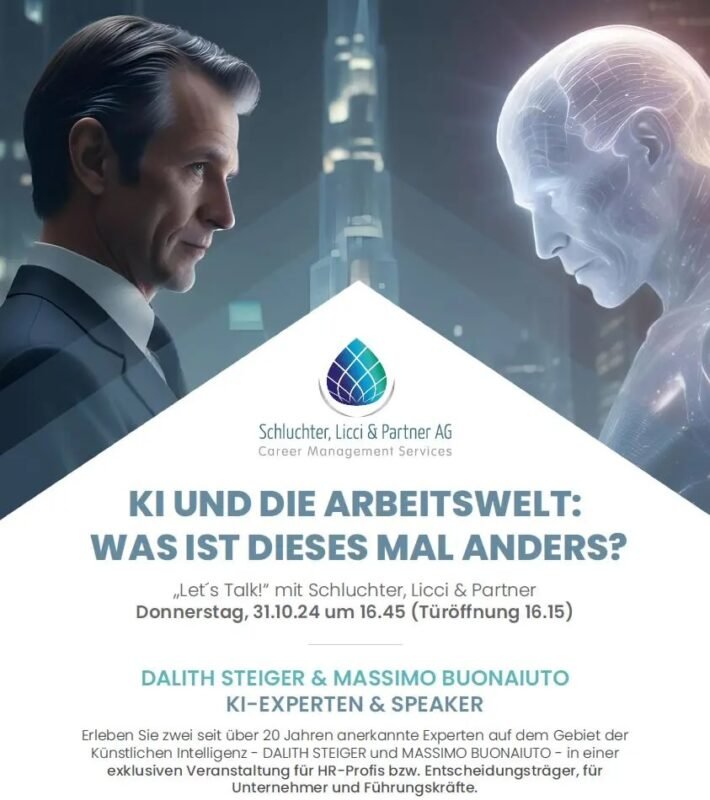
I will be a lead speaker at the “LET’S TALK” event, 31 October 2024 | Zurich, Switzerland.
For years, we’ve explored the rapidly shifting dynamics of work under Industry 4.0, characterized by new ways of working, digital transformations, and the rise of innovative leadership. The future workplace will undoubtedly look vastly different from today’s. Since the advent of accessible AI technologies like ChatGPT, the speed of digital transformation has skyrocketed, fundamentally reshaping industries and workflows. But amid this technological revolution, one pressing question remains: which strategies truly drive success in today’s organizations?
In both professional and personal circles, key questions continue to spark debate:
As we stand on the brink of this new era, the answers to these questions will define the future of work.
Dalith Steiger and Massimo Buonaiuto, two renowned experts in the field of artificial intelligence and internationally sought-after speakers, will be in Zurich on 31 October 2024 to shed light on the opportunities, risks and dangers of AI, the current possibilities and challenges, from the following perspectives.
 Dalith Steiger-Gablinger (Venture Partner, AI Strategist, Innovator, Keynote Speaker, Co-Founder SwissCognitive) will focus on the ‘interface’ between people and technology and highlight the opportunities beyond the risks: she addresses concerns and fears, shows how AI is successfully introduced into the corporate world in practice and which principles must be observed in order to be able to use the opportunities offered by AI. She says: “AI IS MORE THAN JUST TECHNOLOGY!”

Massimo Buonaiuto (Director AI at EPAM, AI-Transformation Leader from the very beginning) will highlight the real risks we face. He will explore what society, business leaders, managers, and employees must focus on to avoid being overwhelmed by these advancements, and instead play an active role in shaping the future. Massimo will reveal the hidden dangers and the radical changes that will happen in AI-First companies, especially in recruitment processes, impact of AI automation on Corporate Organizational Structures, talent mismatching and the challenges of team working with AI agents… He states: Generative AI – This time it’s different! Be the revolution!
The organizer: https://www.schluchterlicci.ch/e/company/
Venue:
In recent discourse, particularly in professional conferences, the potential for Artificial Intelligence (AI) to supplant human roles has been a topic of intense debate. I have often presented the argument, using the role of a secretary as an exemplar, demonstrating how Generative AI could feasibly undertake between 45% to 60% of tasks traditionally assigned to secretarial staff. Furthermore, I’ve highlighted the possibility that AI could impact up to 80% of women in the western world, underscoring the profound implications AI holds for the workforce.


Further examination into the digital marketing sphere suggested a startling forecast: approximately 75% of roles within this domain could vanish within the next three to five years due to AI integration:


Today, the Institute for Public Policy Research (IPPR) published a study forecasting the influence of AI on the UK job market over the next three to five years. This report specifically highlights the anticipated replacement of secretarial roles by AI in numerous tasks, confirming the predictions I had made earlier.
Entry level, part-time and administrative jobs will be the most exposed to being replaced by AI under a “worst-case scenario”.
Substantial Gains with Government Action: The IPPR posits that AI could lead to significant wage and productivity gains if the UK government implements appropriate policies. The current moment is described as a “sliding doors” scenario, where government action could determine the extent to which AI disrupts the job market or leads to a “job apocalypse.”


In the tapestry of the modern economy, Artificial Intelligence (AI) emerges as both a harbinger of innovation and a potential catalyst for an employment crisis. The intersection of AI’s capabilities with the job market spells a transformative period for the workforce, particularly in the United Kingdom. This analysis ventures into the depths of AI’s impact, unraveling its implications on employment across various sectors, with a focus on those most at risk.
As we stand at this crossroads, it becomes imperative for stakeholders across the spectrum to engage in meaningful dialogue and action. Policymakers, businesses, and individuals must collaborate to shape a future that harnesses AI’s potential while safeguarding against its risks. Whether through further research, policy formulation, or adopting AI with a human-centric approach, the time to act is now. Let us embrace this opportunity to redefine the future of work, ensuring it is inclusive, equitable, and reflective of our shared aspirations for progress and prosperity.

Consider the implications of AI that can produce political discourse, fabricate news, and even draft the holy scriptures of new religions. The emergence of cults or movements based around AI-generated content could redefine the landscape of belief, politics, and identity. The capacity of AI to engage in seemingly human interactions further complicates this scenario, as it becomes increasingly difficult to distinguish between genuine human expression and AI-generated content.
Moreover, AI’s impact extends beyond the manipulation of information. It questions the foundation of our cultural and societal norms. For millennia, human culture and history have been shaped by human experiences and creations. AI introduces an ‘alien’ intelligence capable of producing cultural content without human intervention, potentially leading to a future where human culture is profoundly influenced—or even dominated—by non-human intelligence.
The challenge we face is not just regulating this technology but understanding its capabilities, limitations, and potential impacts on society. The notion that AI could, without achieving traditional markers of sentience, influence human civilization raises fundamental questions about the nature of power, control, and human agency in an increasingly digital world.
Read more about impact of AI on jobs and society clicking here.

In recent discourse, particularly within the realms of professional conferences, the potential for Artificial Intelligence (AI) to supplant human roles has been a topic of intense debate. I have often presented the argument, using the role of a secretary as an exemplar, demonstrating how Generative AI could feasibly undertake between 45% to 60% of tasks traditionally assigned to secretarial staff. Furthermore, I’ve highlighted the possibility that AI could impact up to 80% of women in the western world, underscoring the profound implications AI holds for the workforce.
Further examination into the digital marketing sphere suggested a startling forecast: approximately 75% of roles within this domain could vanish within the next three to five years due to AI integration:
Today, the Institute for Public Policy Research (IPPR) published a study forecasting the influence of AI on the UK job market over the next three to five years. This report specifically highlights the anticipated replacement of secretarial roles by AI in numerous tasks, confirming the predictions I had made earlier.
Entry level, part-time and administrative jobs will be the most exposed to being replaced by AI under a “worst-case scenario”.
Substantial Gains with Government Action: The IPPR posits that AI could lead to significant wage and productivity gains if the UK government implements appropriate policies. The current moment is described as a “sliding doors” scenario, where government action could determine the extent to which AI disrupts the job market or leads to a “job apocalypse.”
In the tapestry of the modern economy, Artificial Intelligence (AI) emerges as both a harbinger of innovation and a potential catalyst for an employment crisis. The intersection of AI’s capabilities with the job market spells a transformative period for the workforce, particularly in the United Kingdom. This analysis ventures into the depths of AI’s impact, unraveling its implications on employment across various sectors, with a focus on those most at risk.
As we stand at this crossroads, it becomes imperative for stakeholders across the spectrum to engage in meaningful dialogue and action. Policymakers, businesses, and individuals must collaborate to shape a future that harnesses AI’s potential while safeguarding against its risks. Whether through further research, policy formulation, or adopting AI with a human-centric approach, the time to act is now. Let us embrace this opportunity to redefine the future of work, ensuring it is inclusive, equitable, and reflective of our shared aspirations for progress and prosperity.
Consider the implications of AI that can produce political discourse, fabricate news, and even draft the holy scriptures of new religions. The emergence of cults or movements based around AI-generated content could redefine the landscape of belief, politics, and identity. The capacity of AI to engage in seemingly human interactions further complicates this scenario, as it becomes increasingly difficult to distinguish between genuine human expression and AI-generated content.
Moreover, AI’s impact extends beyond the manipulation of information. It questions the foundation of our cultural and societal norms. For millennia, human culture and history have been shaped by human experiences and creations. AI introduces an ‘alien’ intelligence capable of producing cultural content without human intervention, potentially leading to a future where human culture is profoundly influenced—or even dominated—by non-human intelligence.
The challenge we face is not just regulating this technology but understanding its capabilities, limitations, and potential impacts on society. The notion that AI could, without achieving traditional markers of sentience, influence human civilization raises fundamental questions about the nature of power, control, and human agency in an increasingly digital world.
Read more about impact of AI on jobs and society clicking here.

I’m thrilled to announce that I’ll be moderating the upcoming roundtable ITDACH Roundtable meeting on Artificial Intelligence and IoT on April 25th, 2024. We’ll be delving into some fascinating topics, including Generative AI in the Enterprise, enhancing creativity and content generation, Natural Language generation (NLG) for business communication, and AI-driven product and service Innovation. We’ll also be exploring the importance of personalization and customer experience, and how to make the most of new technology in corporate organizations.


I will speak at the next Leadership Meeting at Incyte, 14th February 2024 | Morges, Switzerland.
I am pleased to present an overview of the presentation I will make to the Leadership Team of Incyte, a Pharmaceutical Company based in Morges, Switzerland.
I will focus on the transformative role of Generative AI across various sectors in the pharmaceutical industry, including its impact on workforce and key applications in drug development, clinical and commercial supply, manufacturing, quality assurance, and regulatory submissions.
Generative AI and Its Impact on Workforce and Employees: This section will explore how generative AI is reshaping the workforce landscape. We will delve into the potential for enhanced productivity, the creation of new roles, and the necessity for reskilling and upskilling employees to adapt to AI-driven environments.
Application to Drug Development: We will examine how generative AI accelerates drug discovery processes, from identifying new drug candidates to predicting drug-target interactions. The focus will be on the reduction of time and costs, and the increase in the efficiency of R&D processes.
Application to Clinical and Commercial Supply – Planning & Forecasting: This segment will cover how generative AI can revolutionize supply chain management. We will discuss AI’s role in demand forecasting, inventory optimization, and enhancing the agility of supply chain responses to market changes.
Application to Manufacturing: Here, we will explore the integration of generative AI in manufacturing processes. The emphasis will be on predictive maintenance, process optimization, and how AI can aid in scaling production while maintaining high-quality standards.
Application to Quality Assurance: This part will address the utilization of generative AI in quality assurance, focusing on automated quality checks, real-time monitoring, and predictive analytics to anticipate and prevent quality issues.
Application to Regulatory Submission (CMC Submission): Finally, we will discuss the application of generative AI in regulatory submissions, especially in Chemistry, Manufacturing, and Controls (CMC). The focus will be on how AI can streamline data analysis, enhance documentation accuracy, and ensure compliance with evolving regulatory standards. This application promises to significantly reduce the time and resources required for regulatory submissions, while maintaining the highest levels of accuracy and compliance.
Link to the website of the Incyte: https://incyte.com/


I will speak at the next “Young Executives Committee YEX meeting” in collaboration with the Camera di Commercio Italiana per la Svizzera (CCIS), 28th November 2023 | Zurich, Switzerland.
In this compelling presentation, Massimo Buonaiuto, an international speaker and Principal Scientist with over 20 years of experience in data science and AI innovation, describes how Generative AI will empower and revolutionize human society and workplaces.
Massimo offers a nuanced perspective on how ChatGPT can be both an asset and a challenge for employees and employers alike.
Link to the website of the conference: https://ccis.ch/stec_event/yex-zurich-chat-gpt/


I will speak at the next conference “R&D 4.0 Strategy Day “, 30th November 2023 | Zurich, Switzerland.
In this compelling presentation, Massimo Buonaiuto, an international speaker and Principal Scientist with over 20 years of experience in data science and AI innovation, describes how Generative AI will empower revolutionize R&D processes and manufacturing. Drawing from his extensive experience at leading organizations like DSM-Firmenich, United Nations, and Fairtrade Handels, Massimo offers a nuanced perspective on how ChatGPT can be both an asset and a challenge for employees and employers alike.
What are the next steps in R&D transformation? At 4.0 Strategy Day (redev40.com) on Nov 30 in Zurich and online R&D professionals discuss latest R&D trends for the digital age in plenary sessions and networking rounds. Adapting R&D for short innovation cycles, better customer centricity and digital products and business models requires the integration of agile management, (partly) open innovation, capable metrics/KPIs and digital technologies like AI, simulation software or big data analytics.
Pleased to present a very practice-oriented program with keynotes from Silvio Weber (Miltenyi Biotec), Edwige Fiaclou (Swissquote), Matthias Glätzle (ADLER Coatings Group), Fabiano Assi (Federal Institute of Metrology), Sebastian Grimm (ZF Group), Jens Koehler (BASF), Till Kuehn (Bruker BioSpin), Dr. Quy Vo-Reinhard (DHealth), Marcus Chambers (Vectura Fertin Pharma), Jorit J. K. Schmelzle (Peregrine.ai), Andreas Schweiger, Massimo Buonaiuto (DSM)
Agenda: click here
Link to the website of the conference: https://redev40.com/

R&D with its active impact on value chains, portfolios and business models sets the foundation for corporate digitalization towards Industry 4.0. R&D 4.0 Strategy Day helps professionals to expand their knowledge about R&D transformation by highlighting successful corporate strategies, use cases and latest scientific insights in presentations and discussions. Additionally, we offer time and space for one-on-one and group networking, which attendees can schedule themselves by our networking app.

I will speak at the next conference “WORLD SMART BIOPROCESSING SUMMIT – PHARMA 4.0“, 27th – 29th September 2023 | Berlin, Germany.
In this compelling presentation, Massimo Buonaiuto, an international speaker and Principal Scientist with over 20 years of experience in data science and AI innovation, delves into the transformative potential of ChatGPT in revolutionizing R&D processes and manufacturing. Drawing from his extensive experience at leading organizations like DSM-Firmenich, United Nations, and Fairtrade Handels, Massimo offers a nuanced perspective on how ChatGPT can be both an asset and a challenge for employees and employers alike.
Key Takeaways:
Opportunities:
Threats:
Agenda: click here
Link to the website of the conference: https://www.cparityevent.com/world-smart-bioprocessing/

Today’s Bioprocessing is the base of several emerging industries and technologies, including the production of therapeutic stem cells, gene therapy vectors, and new vaccines. Advances in Bioprocessing is a particular interest to the industry as it considerably shortens the development timeline, improves the final product and increase the productivity of Bio-manufacturing facilities.
World Smart Bioprocessing: Pharma 4.0 Summit is a world platform across the Pharma & Biopharmaceutical Manufacturing community to present their technological advances, to boost innovation and exchange insights on current challenges. The event will gather top leaders in a 3-day event, aiming to promote a high level participation to provide the appropriate environment for dialogue with peers from pharma, biotech, schools, and pharma suppliers to maximize our efforts and profit in the industry. This Summit program comprises complex case studies, workshops, panels and breakouts. It will combine forward-thinking leaders from different industries to discuss a range of topics on Bioprocessing and Smart manufacturing. We will approach main challenges, innovations and new technologies.


Gartner has recently released the Emerging Technologies and Trends Impact Radar for 2023, which highlights 26 emerging trends and technologies that vendors must respond to in order to improve and differentiate their products. The report reveals four emerging technologies that will be especially interesting: neuromorphic computing, self-supervised learning, the metaverse, and human-centered AI. These technologies will disrupt the market in the next three to eight years and significantly impact existing products and markets. Neuromorphic computing will enable better AI systems, self-supervised learning will accelerate productivity, the metaverse will provide an immersive digital environment, and human-centered AI will improve transparency and privacy.
These technologies will require a shift in strategy, investments, and tools to stay ahead of the competition. The impact of these technologies will be significant, as they will lead to new business and monetization opportunities.
The year 2023 marks an era of revolutionary changes in the world of productivity, thanks to the advancements in Artificial Intelligence (AI). The fusion of Edge Computing, Vision, Edge AI, Model Compression, Self-Supervised Learning, Synthetic Data, Intelligent Applications, and Generative AI has unlocked endless possibilities for businesses, industries, and individuals to boost their efficiency, accuracy, and innovation. In this article, we will delve deeper into each of these AI-powered tools and explore how they are driving the Productivity Revolution in 2023:
1) Edge Computing: Edge Computing is the game-changer that has disrupted traditional centralized computing models. It involves processing data at the edge of the network, i.e., closer to the source of data generation, which enables faster processing, lower latency, and reduced bandwidth requirements. Edge Computing is particularly useful for AI applications that require real-time processing, such as autonomous vehicles, smart cities, and healthcare monitoring systems. Edge Computing Vision is another critical tool that involves using computer vision algorithms to interpret and analyze visual data, such as images and videos, and extract meaningful insights. It is being used in various industries, such as retail, healthcare, and manufacturing, to automate tasks, improve safety, and enhance customer experiences.
2) Edge AI: Edge AI combines the power of Edge Computing and AI to bring AI processing capabilities closer to the data source. This eliminates the need for large-scale data transfers and cloud computing, making AI more accessible and cost-effective. Edge AI is particularly useful for applications that require low latency, such as real-time video analytics, industrial automation, and smart homes.
3) Model Compression: Model Compression involves reducing the size and complexity of AI models without compromising their accuracy. This enables AI models to run faster and more efficiently, even on low-power devices. Model Compression is particularly useful for Edge AI applications that require lightweight models, such as mobile devices, smartwatches, and IoT sensors.
4) Self-Supervised Learning: Self-Supervised Learning is an AI training method that enables models to learn from unlabelled data, i.e., data without explicit annotations. This reduces the need for human-labeled data, which is often expensive and time-consuming to acquire. Self-Supervised Learning is being used in various industries, such as natural language processing, computer vision, and speech recognition, to improve accuracy and reduce training time.
5) Synthetic Data: Synthetic Data involves generating artificial data that mimics real-world data. This enables AI models to be trained on larger and more diverse datasets, which improves their accuracy and generalizability. Synthetic Data is particularly useful for applications that require large amounts of training data, such as autonomous driving, facial recognition, and fraud detection.
6) Intelligent Applications: Intelligent Applications are AI-powered applications that can perform complex tasks, such as natural language processing, sentiment analysis, and image recognition. Intelligent Applications are being used in various industries, such as healthcare, finance, and marketing, to automate tasks, improve decision-making, and enhance user experiences.
7) Generative AI (ChatGPT): Generative AI involves using AI models to generate new and original content, such as images, music, and text. Generative AI is being used in various industries, such as gaming, art, and design, to create unique and personalized content.

I will speak at the next conference “Swiss data leaders – Leaders dialog on Big Data & AI” – in Zurich, 22nd March 2023.
Link to the website of the conference in pdf format: click here.
Link to the website of the conference: https://leadersdialog.com/?page_id=1524
Join me at the Leadership Exchange on Digitalization Strategies to discover how data science and knowledge management can help Companies unlocking the full potential of Big Data and AI. Learn about the importance of a solid data governance framework and how to navigate the complex Big Data and AI ecosystems to gain a competitive edge in R&D environment. Let’s explore together the diverse strategies and use cases that will enable Companies to develop future-proof strategies in a VUCA world (=volatility, uncertainty, complexity, and ambiguity world). Don’t miss this opportunity to stay ahead of the latest digitalization trends and new ways of management. See you there!
Data is key in the connected 4.0 economy. Yet no company has been able to fully unlock the potential Big Data and AI bear for supporting strategies, business models, practices and products. Front-runners proved well-applied big data analytics and AI can be decisive for a competitive edge. We’ve been discussing many of these cases at our Dialogs in recent years. It goes without saying companies need a data strategy – based on a solid data governance framework – to be successful. The never-ending increase of connected touchpoints in digitalized societies makes it easy to collect huge amounts of data and data science helps to decide which data to collect and how to analyze it. But complex Big Data and AI ecosystems bear the risk of choosing wrong suppliers, partners and architecture. “One size fits all” does not exist. For more orientation, digitalization and data leaders discuss diverse strategies and use cases at this summit.
It is challenging for executives and their teams to develop future-proof strategies in a VUCA world. At Leaders Dialog we discuss latest digitalization trends, new business models and new ways of management. We look into the latest implications and applications of AI, Big Data, Servitization and Industry 4.0.
New Digital Business Models & Servitization


[blockquote align=”none” author=”Tongzhou Wang – MIT CSAIL“]The world contains a lot of information that’s irrelevant for you to be able to navigate it. At the core of many Machine Learning techniques is the ability to discern relevant and useful signals — or patterns — from noise..[/blockquote]
This work formalizes the problem of separating “the good from the irrelevant information” in the context of reinforcement learning by identifying information that’s both controllable by the agent and relevant for the reward, as described in the figure below.

Based on this idea, the authors propose Denoised MDPs (Markov Decision Process), a method for learning a factorization of state representations that disentangles the controllable and reward-relevant bit of the state using information theoretic principles. The gist of it is that different factors of the state should be maximally or minimally predictive of other factors depending on their relationship, which enables the authors to set up a variational objective for the agent to optimize.
The result is a world model that explicitly models what information should be discarded as noise and what information should be used for modelling the agent’s decisions. The authors prove how this approach is competitive in the DeepMind Control Suite, and fascinatingly, they showcase qualitatively how the Denoised MDP representations work by training a decoder on reconstructing the input so you can understand what the signal representation of the state learns to capture.
The ability to separate signal from noise, and reason with clean abstractions, is critical to intelligence. With this ability, humans can efficiently perform real world tasks without considering all possible nuisance factors. How can artificial agents do the same? What kind of information can agents safely discard as noises? In this work, we categorize information out in the wild into four types based on controllability and relation with reward, and formulate useful information as that which is both controllable and reward-relevant.
This framework clarifies the kinds of information removed by various prior work on representation learning in reinforcement learning (RL), and leads to our proposed approach of learning a Denoised MDP that explicitly factors out certain noise distractors. Extensive experiments on variants of DeepMind Control Suite and RoboDesk demonstrate superior performance of our denoised world model over using raw observations alone, and over prior works, across policy optimization control tasks as well as the non-control task of joint position regression.
Link to the project: https://www.tongzhouwang.info/denoised_mdp/
Tongzhou Wang, Simon S. Du, Antonio Torralba, Phillip Isola, Amy Zhang, Yuandong Tian. “Denoised MDPs: Learning World Models Better Than The World Itself” International Conference on Machine Learning (ICML). 2022.


