



I am thrilled to announce my upcoming interview with national Radio LoRa, Switzerland’s oldest community radio station, to discuss the transformative impact of Artificial Intelligence and Generative AI for business and our lives.
For the first time in history, we are encountering AI agents that surpass human intelligence in various tasks. This unprecedented development presents both opportunities and challenges.
As AI agents increasingly surpass human capabilities in various tasks, we find ourselves at a crossroads that presents both incredible opportunities and formidable challenges. This conversation is timely, especially in light of recent warnings from the latest Turing Award winners, Andrew Barto and Richard Sutton, about the perils of rushing AI models to market without adequate safety measures.
In our discussion, indeed we will tackle profound questions such as:
• This time is different: why Generative AI promises to make a revolution in human history.
• How will AI reshape our daily lives and our jobs? The big transition.
• How can businesses and workers harness this new revolution for the better?
With around 300 dedicated program makers broadcasting in 20 different languages, Radio LoRa provides a unique platform for this important discussion in Switzerland.
Join me as we explore strategies to navigate one of the most significant revolutions in human history.
Stay tuned for insights and reflections on how we can harness the power of AI to drive positive change and innovation.
Link Radio LoRa: https://www.lora.ch/
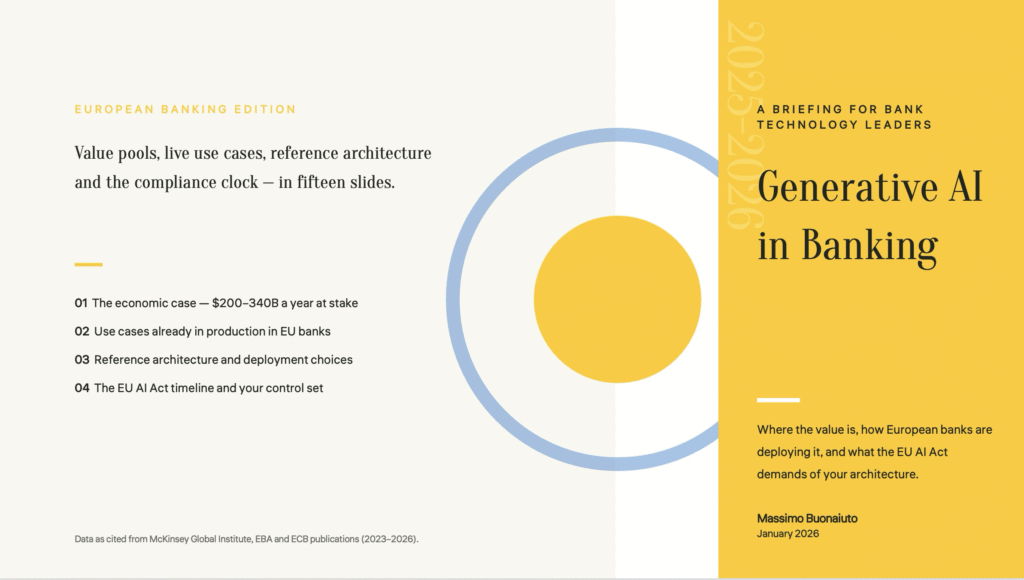
This post is a written companion to a presentation I gave at a 2025 conference on Generative AI applied to banking. Downoad the presentation in PDF and PowerPoint.
The talk — “Generative AI in Banking”, a fifteen-slide, in-depth analysis prepared for technology directors of European banks — walked through where the economic value sits, which use cases are already live in EU institutions, how to architect for it, and what the EU AI Act demands of every deployment. This article covers the same ground in long form; if you attended the session, consider this the extended version of the deck.
1. Customer operations — the first production beachhead.
Volumes are high, text-heavy, and quality is measurable. Generative AI assistants resolve customer queries and answer employees’ questions on internal policies; models transcribe and summarise contact-centre audio and draft next-best responses for operators. Resolution rate, handle time and customer satisfaction give a clean before/after read — rare for AI projects. And because routine queries sit outside regulated decision-making, early deployments rarely trigger high-risk obligations.
2. Software engineering — your own developers are the fastest payback.
Banks use general-purpose AI to generate code from natural language, detect errors, support testing, convert between languages and migrate legacy systems — a structural problem in European core banking estates. Coding assistants can run against internal repositories under the bank’s own access controls, so no customer data leaves the perimeter. It also compounds: faster delivery accelerates every other AI initiative on the roadmap. For context, significant euro area banks invested over in digital technologies including AI in 2025 (~1.3% of tangible assets, ECB).
| Risk (as observed by the EBA) | Control (built into the platform) |
|---|---|
| Hallucinations and inaccurate output | Ground every answer via RAG over verified sources; block free-form generation in customer flows; human review for consequential replies |
| Input-data quality, governance and consent | Curated, versioned, quality-checked corpora; GDPR consent and purpose limitation enforced at the data layer |
| Reliance on third parties | Model routing as insurance: at least two qualified models per critical flow; DORA register, exit plans, portability tests |
| Opaque logic | Log prompts, sources and outputs; generate customer-facing reason statements from the same record |
In recent discourse, particularly in professional conferences, the potential for Artificial Intelligence (AI) to supplant human roles has been a topic of intense debate. I have often presented the argument, using the role of a secretary as an exemplar, demonstrating how Generative AI could feasibly undertake between 45% to 60% of tasks traditionally assigned to secretarial staff. Furthermore, I’ve highlighted the possibility that AI could impact up to 80% of women in the western world, underscoring the profound implications AI holds for the workforce.


Further examination into the digital marketing sphere suggested a startling forecast: approximately 75% of roles within this domain could vanish within the next three to five years due to AI integration:


Today, the Institute for Public Policy Research (IPPR) published a study forecasting the influence of AI on the UK job market over the next three to five years. This report specifically highlights the anticipated replacement of secretarial roles by AI in numerous tasks, confirming the predictions I had made earlier.
Entry level, part-time and administrative jobs will be the most exposed to being replaced by AI under a “worst-case scenario”.
Substantial Gains with Government Action: The IPPR posits that AI could lead to significant wage and productivity gains if the UK government implements appropriate policies. The current moment is described as a “sliding doors” scenario, where government action could determine the extent to which AI disrupts the job market or leads to a “job apocalypse.”


In the tapestry of the modern economy, Artificial Intelligence (AI) emerges as both a harbinger of innovation and a potential catalyst for an employment crisis. The intersection of AI’s capabilities with the job market spells a transformative period for the workforce, particularly in the United Kingdom. This analysis ventures into the depths of AI’s impact, unraveling its implications on employment across various sectors, with a focus on those most at risk.
As we stand at this crossroads, it becomes imperative for stakeholders across the spectrum to engage in meaningful dialogue and action. Policymakers, businesses, and individuals must collaborate to shape a future that harnesses AI’s potential while safeguarding against its risks. Whether through further research, policy formulation, or adopting AI with a human-centric approach, the time to act is now. Let us embrace this opportunity to redefine the future of work, ensuring it is inclusive, equitable, and reflective of our shared aspirations for progress and prosperity.

Consider the implications of AI that can produce political discourse, fabricate news, and even draft the holy scriptures of new religions. The emergence of cults or movements based around AI-generated content could redefine the landscape of belief, politics, and identity. The capacity of AI to engage in seemingly human interactions further complicates this scenario, as it becomes increasingly difficult to distinguish between genuine human expression and AI-generated content.
Moreover, AI’s impact extends beyond the manipulation of information. It questions the foundation of our cultural and societal norms. For millennia, human culture and history have been shaped by human experiences and creations. AI introduces an ‘alien’ intelligence capable of producing cultural content without human intervention, potentially leading to a future where human culture is profoundly influenced—or even dominated—by non-human intelligence.
The challenge we face is not just regulating this technology but understanding its capabilities, limitations, and potential impacts on society. The notion that AI could, without achieving traditional markers of sentience, influence human civilization raises fundamental questions about the nature of power, control, and human agency in an increasingly digital world.
Read more about impact of AI on jobs and society clicking here.

In recent discourse, particularly within the realms of professional conferences, the potential for Artificial Intelligence (AI) to supplant human roles has been a topic of intense debate. I have often presented the argument, using the role of a secretary as an exemplar, demonstrating how Generative AI could feasibly undertake between 45% to 60% of tasks traditionally assigned to secretarial staff. Furthermore, I’ve highlighted the possibility that AI could impact up to 80% of women in the western world, underscoring the profound implications AI holds for the workforce.
Further examination into the digital marketing sphere suggested a startling forecast: approximately 75% of roles within this domain could vanish within the next three to five years due to AI integration:
Today, the Institute for Public Policy Research (IPPR) published a study forecasting the influence of AI on the UK job market over the next three to five years. This report specifically highlights the anticipated replacement of secretarial roles by AI in numerous tasks, confirming the predictions I had made earlier.
Entry level, part-time and administrative jobs will be the most exposed to being replaced by AI under a “worst-case scenario”.
Substantial Gains with Government Action: The IPPR posits that AI could lead to significant wage and productivity gains if the UK government implements appropriate policies. The current moment is described as a “sliding doors” scenario, where government action could determine the extent to which AI disrupts the job market or leads to a “job apocalypse.”
In the tapestry of the modern economy, Artificial Intelligence (AI) emerges as both a harbinger of innovation and a potential catalyst for an employment crisis. The intersection of AI’s capabilities with the job market spells a transformative period for the workforce, particularly in the United Kingdom. This analysis ventures into the depths of AI’s impact, unraveling its implications on employment across various sectors, with a focus on those most at risk.
As we stand at this crossroads, it becomes imperative for stakeholders across the spectrum to engage in meaningful dialogue and action. Policymakers, businesses, and individuals must collaborate to shape a future that harnesses AI’s potential while safeguarding against its risks. Whether through further research, policy formulation, or adopting AI with a human-centric approach, the time to act is now. Let us embrace this opportunity to redefine the future of work, ensuring it is inclusive, equitable, and reflective of our shared aspirations for progress and prosperity.
Consider the implications of AI that can produce political discourse, fabricate news, and even draft the holy scriptures of new religions. The emergence of cults or movements based around AI-generated content could redefine the landscape of belief, politics, and identity. The capacity of AI to engage in seemingly human interactions further complicates this scenario, as it becomes increasingly difficult to distinguish between genuine human expression and AI-generated content.
Moreover, AI’s impact extends beyond the manipulation of information. It questions the foundation of our cultural and societal norms. For millennia, human culture and history have been shaped by human experiences and creations. AI introduces an ‘alien’ intelligence capable of producing cultural content without human intervention, potentially leading to a future where human culture is profoundly influenced—or even dominated—by non-human intelligence.
The challenge we face is not just regulating this technology but understanding its capabilities, limitations, and potential impacts on society. The notion that AI could, without achieving traditional markers of sentience, influence human civilization raises fundamental questions about the nature of power, control, and human agency in an increasingly digital world.
Read more about impact of AI on jobs and society clicking here.

I’m thrilled to announce that I’ll be moderating the upcoming roundtable ITDACH Roundtable meeting on Artificial Intelligence and IoT on April 25th, 2024. We’ll be delving into some fascinating topics, including Generative AI in the Enterprise, enhancing creativity and content generation, Natural Language generation (NLG) for business communication, and AI-driven product and service Innovation. We’ll also be exploring the importance of personalization and customer experience, and how to make the most of new technology in corporate organizations.


I will speak at the next Leadership Meeting at Incyte, 14th February 2024 | Morges, Switzerland.
I am pleased to present an overview of the presentation I will make to the Leadership Team of Incyte, a Pharmaceutical Company based in Morges, Switzerland.
I will focus on the transformative role of Generative AI across various sectors in the pharmaceutical industry, including its impact on workforce and key applications in drug development, clinical and commercial supply, manufacturing, quality assurance, and regulatory submissions.
Generative AI and Its Impact on Workforce and Employees: This section will explore how generative AI is reshaping the workforce landscape. We will delve into the potential for enhanced productivity, the creation of new roles, and the necessity for reskilling and upskilling employees to adapt to AI-driven environments.
Application to Drug Development: We will examine how generative AI accelerates drug discovery processes, from identifying new drug candidates to predicting drug-target interactions. The focus will be on the reduction of time and costs, and the increase in the efficiency of R&D processes.
Application to Clinical and Commercial Supply – Planning & Forecasting: This segment will cover how generative AI can revolutionize supply chain management. We will discuss AI’s role in demand forecasting, inventory optimization, and enhancing the agility of supply chain responses to market changes.
Application to Manufacturing: Here, we will explore the integration of generative AI in manufacturing processes. The emphasis will be on predictive maintenance, process optimization, and how AI can aid in scaling production while maintaining high-quality standards.
Application to Quality Assurance: This part will address the utilization of generative AI in quality assurance, focusing on automated quality checks, real-time monitoring, and predictive analytics to anticipate and prevent quality issues.
Application to Regulatory Submission (CMC Submission): Finally, we will discuss the application of generative AI in regulatory submissions, especially in Chemistry, Manufacturing, and Controls (CMC). The focus will be on how AI can streamline data analysis, enhance documentation accuracy, and ensure compliance with evolving regulatory standards. This application promises to significantly reduce the time and resources required for regulatory submissions, while maintaining the highest levels of accuracy and compliance.
Link to the website of the Incyte: https://incyte.com/


Gemini, the new AI model from Google, was developed using Jax and TPUs, with its architecture showing similarities to DeepMind’s Flamigo, featuring separate text and vision encoders. Gemini Pro’s performance is on par with GPT-3.5, while Gemini Ultra outperforms GPT-4, marking a significant advancement in AI capabilities. The introduction of Nano-1 and Nano-2, designed for on-device operation, adds an intriguing dimension to Gemini’s versatility and potential applications.
Gemini, the eagerly anticipated newcomer to the world of artificial intelligence, has finally made its debut. With its technical report in hand, enthusiasts and experts alike have been eager to dissect the inner workings of this groundbreaking model.
Clocking in at a substantial 60 pages, the report, while comprehensive, leaves some craving more detailed insights. In this article, we embark on a journey through the core findings of Gemini’s technical report, offering a concise summary of its key highlights.
1. The Language and Hardware: Gemini takes its first steps in the world of AI with Jax as its chosen language, and it flexes its computational muscles on TPUs (Tensor Processing Units). While the report doesn’t delve into the nitty-gritty of the architecture, it hints at similarities to DeepMind’s Flamigo, featuring distinct text and vision encoders.
2. Performance Unveiled: Perhaps the most eagerly anticipated aspect of Gemini’s debut is its performance. Preliminary reports suggest that Gemini Pro stands shoulder-to-shoulder with the formidable GPT-3.5. However, the real star of the show is Gemini Ultra, which claims to surpass the prowess of even GPT-4. Additionally, the introduction of Nano-1 and Nano-2, designed to run on-device, adds an intriguing dimension to Gemini’s versatility.
In the following sections, we’ll dive deeper into these revelations, dissecting the implications of Gemini’s technical choices and its potential impact on the AI landscape. Stay tuned for a thorough exploration of this groundbreaking addition to the AI pantheon.


Read more here: https://blog.google/technology/ai/google-gemini-ai/#capabilities

I will speak at the next “Young Executives Committee YEX meeting” in collaboration with the Camera di Commercio Italiana per la Svizzera (CCIS), 28th November 2023 | Zurich, Switzerland.
In this compelling presentation, Massimo Buonaiuto, an international speaker and Principal Scientist with over 20 years of experience in data science and AI innovation, describes how Generative AI will empower and revolutionize human society and workplaces.
Massimo offers a nuanced perspective on how ChatGPT can be both an asset and a challenge for employees and employers alike.
Link to the website of the conference: https://ccis.ch/stec_event/yex-zurich-chat-gpt/


I will speak at the next conference “R&D 4.0 Strategy Day “, 30th November 2023 | Zurich, Switzerland.
In this compelling presentation, Massimo Buonaiuto, an international speaker and Principal Scientist with over 20 years of experience in data science and AI innovation, describes how Generative AI will empower revolutionize R&D processes and manufacturing. Drawing from his extensive experience at leading organizations like DSM-Firmenich, United Nations, and Fairtrade Handels, Massimo offers a nuanced perspective on how ChatGPT can be both an asset and a challenge for employees and employers alike.
What are the next steps in R&D transformation? At 4.0 Strategy Day (redev40.com) on Nov 30 in Zurich and online R&D professionals discuss latest R&D trends for the digital age in plenary sessions and networking rounds. Adapting R&D for short innovation cycles, better customer centricity and digital products and business models requires the integration of agile management, (partly) open innovation, capable metrics/KPIs and digital technologies like AI, simulation software or big data analytics.
Pleased to present a very practice-oriented program with keynotes from Silvio Weber (Miltenyi Biotec), Edwige Fiaclou (Swissquote), Matthias Glätzle (ADLER Coatings Group), Fabiano Assi (Federal Institute of Metrology), Sebastian Grimm (ZF Group), Jens Koehler (BASF), Till Kuehn (Bruker BioSpin), Dr. Quy Vo-Reinhard (DHealth), Marcus Chambers (Vectura Fertin Pharma), Jorit J. K. Schmelzle (Peregrine.ai), Andreas Schweiger, Massimo Buonaiuto (DSM)
Agenda: click here
Link to the website of the conference: https://redev40.com/

R&D with its active impact on value chains, portfolios and business models sets the foundation for corporate digitalization towards Industry 4.0. R&D 4.0 Strategy Day helps professionals to expand their knowledge about R&D transformation by highlighting successful corporate strategies, use cases and latest scientific insights in presentations and discussions. Additionally, we offer time and space for one-on-one and group networking, which attendees can schedule themselves by our networking app.


While OpenAI and Meta bring chatbots closer to human-like interactions, they inadvertently expose the gaps in current AI governance. Existing mechanisms to prevent these systems from venturing into territories of hate speech, misinformation, or criminal activities are notably inadequate. Despite efforts by companies like Google DeepMind and Anthropic to formulate AI “constitutions,” these guidelines are embryonic and often insufficiently robust to prevent the full spectrum of potential abuses.
It’s worth noting that the idea of AI constitutions—sets of principles designed to keep AI behaviour in check—is more aspirational than operational. These frameworks are predominantly designed by AI engineers and tech companies, reflecting a narrow world-view and lacking diverse cultural perspectives. Moreover, they are fraught with ambiguities, leaving room for AI systems to act in ways unpredictably harmful to society.
Companies have traditionally relied on RLHF to train AI models, a method that involves human contractors rating AI responses as “good” or “bad.” However, this mechanism is fundamentally flawed. Not only does it fail to provide nuanced ethical understanding, but it also doesn’t offer transparency into the model’s decision-making process. As Dario Amodei, CEO of Anthropic, points out, RLHF is neither targeted nor accurate, and it leaves a disconcerting amount of “noise” in AI responses.
Researchers have demonstrated that even leading AI models like OpenAI’s ChatGPT and Google’s Bard can be easily manipulated. Simple tricks, such as appending random characters to malicious queries, can bypass the filters designed to keep these platforms in check. It reveals a critical flaw: the brittle nature of these so-called “guardrails,” which can be derailed by trivial manipulations.
One of the most daunting challenges in AI safety is evaluating the efficacy of these ethical frameworks. Given the open-ended nature of these AI models, there is no straightforward way to test their moral and ethical boundaries exhaustively. It poses a significant hurdle, likened by experts to the complexity of evaluating human character.
AI ethics researcher Rebecca Johnson underscores the crux of the issue: the internal rules governing AI are most often the brainchild of engineers and computer scientists, who approach human complexity as a problem to be solved. To navigate this ethical labyrinth effectively, we need a more interdisciplinary approach, incorporating insights from social sciences and philosophy.
While human-written policies aim to govern AI effectively, they face multiple challenges, ranging from the limitations of human foresight to the complexities of ethical enforcement. These shortcomings necessitate a more dynamic, comprehensive approach to AI governance. List of threats to be considered in this case could consider the following issues:
Limited Worldview: Policies often reflect the perspectives of the individuals or organizations that create them. Human biases and limited worldviews can result in incomplete or flawed guidelines for AI behavior.
Rapid Technological Advancements: AI technology evolves at a pace that often outstrips the speed at which human-generated policies can be updated, leading to outdated regulations that fail to address new ethical dilemmas.
Complexity of AI Algorithms: Understanding the intricacies of AI decision-making processes is challenging. Human-written policies may fail to capture the complexity of these algorithms, leading to loopholes.
Inherent Ambiguity: Human language and ethical norms are fraught with ambiguities. When translated into code or guidelines for AI, these ambiguities can result in unintended behaviours.
Lack of Foresight: Humans may fail to foresee all the potential edge cases and scenarios where AI could behave unethically or unpredictably, leading to incomplete or ineffective policies.
Ethical Relativism: What is considered ethical varies between cultures and over time. Human-written policies may lack the flexibility to adapt to these variations, causing the AI to behave in ways that are culturally insensitive or outdated.
Scalability Issues: As AI technologies proliferate, ensuring that every instance adheres to human-written policies becomes increasingly challenging. Monitoring compliance at scale is difficult.
Enforcement Challenges: Even the most well-crafted policies are useless if not properly enforced. The complexity of AI systems can make it difficult to ascertain when and how a policy has been violated.
Narrow Focus: Policies often address specific issues or scenarios but may lack a comprehensive approach that considers the AI’s interactions as a whole, leading to gaps in governance.
Over-Reliance on Quantitative Metrics: Human policies often rely on measurable outcomes for assessment. However, ethical considerations are not always quantifiable, making it difficult to apply these metrics to AI behaviour.
Human Fallibility: Errors and oversights are an inherent part of human nature. Mistakes in policy formulation or interpretation can lead to failures in AI governance.
Resource Constraints: Crafting, updating, and enforcing comprehensive policies require significant resources. Organizations may lack the necessary investment to keep policies current.
Social and Political Factors: Policies are often influenced by social and political pressures, which may result in compromises that dilute the effectiveness of governance measures.
Lack of Interdisciplinary Input: Policies crafted solely by technologists may lack insights from social sciences, ethics, and philosophy, leading to an incomplete understanding of human-AI interaction.
Adaptability and Learning Curve: AI systems learn and adapt over time, which can make static, human-written policies quickly obsolete.

I will speak at the next conference “WORLD SMART BIOPROCESSING SUMMIT – PHARMA 4.0“, 27th – 29th September 2023 | Berlin, Germany.
In this compelling presentation, Massimo Buonaiuto, an international speaker and Principal Scientist with over 20 years of experience in data science and AI innovation, delves into the transformative potential of ChatGPT in revolutionizing R&D processes and manufacturing. Drawing from his extensive experience at leading organizations like DSM-Firmenich, United Nations, and Fairtrade Handels, Massimo offers a nuanced perspective on how ChatGPT can be both an asset and a challenge for employees and employers alike.
Key Takeaways:
Opportunities:
Threats:
Agenda: click here
Link to the website of the conference: https://www.cparityevent.com/world-smart-bioprocessing/

Today’s Bioprocessing is the base of several emerging industries and technologies, including the production of therapeutic stem cells, gene therapy vectors, and new vaccines. Advances in Bioprocessing is a particular interest to the industry as it considerably shortens the development timeline, improves the final product and increase the productivity of Bio-manufacturing facilities.
World Smart Bioprocessing: Pharma 4.0 Summit is a world platform across the Pharma & Biopharmaceutical Manufacturing community to present their technological advances, to boost innovation and exchange insights on current challenges. The event will gather top leaders in a 3-day event, aiming to promote a high level participation to provide the appropriate environment for dialogue with peers from pharma, biotech, schools, and pharma suppliers to maximize our efforts and profit in the industry. This Summit program comprises complex case studies, workshops, panels and breakouts. It will combine forward-thinking leaders from different industries to discuss a range of topics on Bioprocessing and Smart manufacturing. We will approach main challenges, innovations and new technologies.

The rapid advancement of artificial intelligence (AI) technology has had significant implications for the job market, particularly in the context of Skill Biased Technological Change (SBTC) and routinization.
SBTC refers to the trend where technological advancements favour individuals with higher skills and education, leading to increased demand for their expertise. AI, with its ability to automate routine tasks and analyse vast amounts of data, has contributed to this phenomenon. As AI systems are designed to handle routine and repetitive tasks efficiently, they have the potential to replace jobs that involve predictable and rule-based activities.
Routinization complements SBTC by breaking down tasks into standardized components, making them more susceptible to automation. AI technologies excel at automating routine tasks, further amplifying the impact of SBTC. Occupations that rely heavily on repetitive and rule-based activities, such as data entry or certain manufacturing tasks, are at higher risk of disruption due to routinization enabled by AI.
While the deployment of AI has undoubtedly led to job displacement in certain areas, it has also created new opportunities. As routine tasks become automated, there is an increasing demand for individuals with skills that complement AI technology. These include skills related to data analysis, programming, problem-solving, and creativity. The emergence of new job roles, such as AI specialists or data scientists, demonstrates the evolving nature of the job market in response to AI-driven changes.
To adapt to this changing landscape, individuals need to acquire skills that are less susceptible to automation. This involves focusing on developing expertise in areas that require complex decision-making, critical thinking, and interpersonal skills, which are harder for AI systems to replicate.
In conclusion, AI has contributed to SBTC and routinization, leading to job disruption in occupations that involve routine and repetitive tasks. However, it also presents opportunities for individuals to upskill and pursue roles that leverage their unique human capabilities alongside AI technology. Adapting to this evolving job market requires a focus on acquiring skills that complement and augment AI capabilities.

Contrary to the popular belief that job losses to AI are inevitable, recent research conducted by European economists challenges this notion. In a comprehensive study analysing job market data from 2011 to 2019, a group of researchers from prestigious institutions such as Oxford University and the European Central Bank discovered a surprising trend during the first AI boom: read it here.
The researchers specifically examined industries where AI could have the most significant impact and expected a decline in employment. However, their findings contradicted this assumption. Instead of witnessing a decrease, these industries experienced a notable increase in employment, particularly in white-collar positions that were believed to be prime targets for AI automation. In fact, there was a remarkable 5% surge in employment within these sectors.
According to the researchers, these findings provide substantial support for the notion that advanced technologies like AI can actually bolster the demand for skilled workers. Rather than completely replacing human labor, AI is being utilized as a tool that complements and enhances the capabilities of skilled professionals.
This research challenges the prevailing narrative of AI-induced job losses and highlights the potential for collaboration between humans and AI technologies. Rather than being threatened by AI, workers can adapt and capitalize on the growing demand for their skills alongside these advanced technologies.
While some jobs may be susceptible to automation, the research emphasizes the importance of acquiring and honing skills that are complementary to AI. Industries that leverage the power of AI are witnessing a surge in employment opportunities, particularly for individuals who possess the expertise to effectively harness the potential of AI-driven technologies.
In conclusion, the research conducted by European economists sheds light on a more optimistic perspective regarding AI and job disruption. It suggests that AI can contribute to the creation of new employment opportunities, particularly within industries where AI has the potential to be most beneficial. By recognizing the increasing demand for skilled workers in conjunction with AI, individuals can position themselves for success in the evolving job market.

The authors of this paper did not consider ChatGPT, that came out just recently. It has the potential to transform the labour market by automating certain tasks traditionally performed by human workers.
The use of ChatGPT can streamline and enhance communication processes, leading to increased efficiency and productivity in various industries. With the ability to generate human-like responses and assist in customer service, ChatGPT can reduce the need for manual interactions, potentially impacting employment in call centers and customer support roles.
The implementation of AI-powered chatbots and virtual assistants, like ChatGPT, may result in a shift in job requirements towards skills related to managing and overseeing AI systems rather than directly handling customer interactions. While ChatGPT can automate routine tasks, it also creates new opportunities for individuals with expertise in AI development, natural language processing, and machine learning, as organizations will require professionals to design, train, and maintain AI systems.


